PTO Accrual Calculator
This free PTO accrual calculator shows how much paid time off you have earned so far. It also projects your balance on any future date, and it names the first day you can afford the trip you are planning. Enter your numbers below and the results update instantly.
- Hourly and salaried
- Accrual caps modelled
- Full accrual schedule
- Runs in your browser
Calculator inputs
Your results
Enter your details and press calculate.
See your full accrual schedule, period by period
| Pay date | Accrued | Balance (hrs) | Balance (days) |
|---|---|---|---|
| Run the calculator to build your schedule. | |||
Why this PTO accrual calculator beats the rest
Most paid time off tools hand you one number. Then they ask for your work email. This PTO accrual calculator does the opposite. It shows the whole picture, and it asks for nothing.
All three accrual methods
Choose per pay period, per hour worked, or a flat annual allowance. You can switch between them and compare, and the page never reloads.
A real accrual schedule
See every pay date, the hours added, and your running balance in hours and days. Most rivals show one figure and hide the maths.
Accrual caps modelled properly
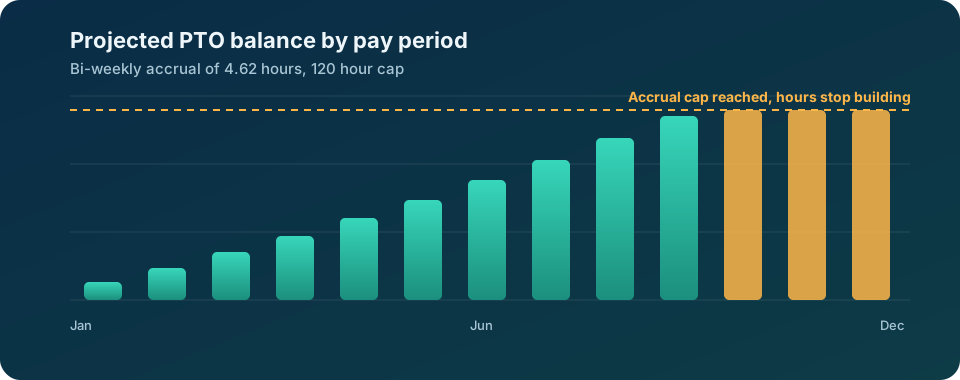
Does your employer cap the balance? If so, we show the exact date you stop earning. We also show the hours you are about to forfeit.
Vacation feasibility date
Tell us how many days off you want. In return we give you the first pay date your balance covers it, so you can request leave with confidence.
Private by design
Every calculation runs locally in your browser. As a result, no accounts, no tracking, and no data leaving your device.
Fast and accessible
There are no frameworks, no chat widgets, and no popups. The tool is keyboard friendly, screen reader labelled, and readable on a small phone.
How to use the PTO accrual calculator
Pick your accrual method
Salaried staff usually earn a set number of hours each pay period. Hourly and part-time staff normally earn PTO per hour worked. If you only know your yearly entitlement, choose annual allowance instead.
Set your pay frequency
Bi-weekly means 26 pay periods a year. Semi-monthly means 24. These are not the same thing, and confusing them is the most common source of wrong PTO maths.
Enter your rate and current balance
Take the accrual rate straight from your payslip or HR portal. Then add carryover hours to your current balance. Finally, put approved but undeducted leave in the booked field.
Choose your projection window
Set the start date to today, or to the start of your accrual year. Then set the end date to your review date, to year end, or to the month you want to travel.
Add your cap and workday length
Enter your ceiling if your policy has one, because the projection needs to stop at the right point. Workday length turns hours into the days figure your manager will ask about.
Read the schedule, not just the total
Open the accrual schedule to see when each block of hours lands. That is how you find the earliest realistic date to request leave.
How PTO accrual is actually calculated
Every policy comes down to the same idea. You have a rate, you multiply it by time, you add it to a balance, and you subtract what you spend. Only the way the rate is written changes. Our PTO accrual calculator handles all three formats for you.
Accrual per pay period
Divide your annual PTO hours by your number of pay periods. For example, 120 hours a year on a bi-weekly cycle is 4.62 hours per paycheque. This is the most common salaried setup.
Accrual per hour worked
Divide annual PTO hours by annual hours worked. So 80 hours across 2,080 working hours gives 0.0385 hours of PTO per hour on the clock. Part-time staff then accrue in proportion.
Annual allowance
Some employers grant the full entitlement up front on your anniversary. Others spread it across the year. If yours spreads it, the calculator divides it across your pay periods for you.
Caps, carryover and forfeiture
A cap freezes accrual once your balance hits a ceiling. Carryover limits what rolls into next year. Use-it-or-lose-it wipes the rest. In short, caps are the quiet reason people lose earned leave.
Rules vary widely by employer and by state. The US Department of Labor does not require paid vacation at all, so your handbook and your state law decide what you are owed. Always read both before you rely on a balance.
Who should track PTO accrual closely
A PTO accrual calculator is not just an HR tool. These groups gain the most from checking a balance regularly.
Employees planning a trip
Find the earliest date that covers the leave you want. Then stop guessing whether your request will survive a balance check.
Anyone near a cap
Spot the month you stop accruing before it arrives. You can then take a long weekend instead of quietly forfeiting hours you already earned.
Hourly and part-time workers
Your accrual scales with the hours you actually work. Because an irregular schedule makes that hard to predict, a PTO accrual calculator removes the guesswork.
Managers and small business owners
Sanity check what payroll produced, forecast your accrued leave liability, and answer balance questions in a meeting without opening the HR system.
People changing jobs
Work out what your accrued balance is worth before you resign. That way you know what is on the table in a final paycheque conversation.
Anyone auditing HR
Payroll systems do get accrual wrong, especially after a raise or a schedule change. An independent check takes about thirty seconds.
PTO accrual calculator: frequently asked questions
How do I calculate my PTO accrual rate?
Divide your total annual PTO hours by the number of accrual periods in your year. On a bi-weekly payroll there are 26 periods. So 120 annual hours gives a rate of 4.62 hours per pay period. If you accrue per hour worked, divide annual PTO hours by annual hours worked instead. For example, 80 hours over 2,080 hours worked is 0.0385 hours earned per hour.
How many PTO hours do you accrue per pay period if you are paid bi-weekly?
It depends on your entitlement. Two weeks of leave, or 80 hours, works out at roughly 3.08 hours per bi-weekly pay period. Three weeks, or 120 hours, gives about 4.62 hours. Four weeks, or 160 hours, gives about 6.15 hours. Semi-monthly payroll has 24 periods rather than 26, so the same entitlement produces a slightly higher figure each period.
How do I convert PTO hours into days?
Divide your balance by the length of your standard workday. With an eight hour day, 100 accrued hours becomes 12.5 days. However, staff on ten hour shifts get only 10 days from the same balance. That is why the workday length field matters, and why comparing raw hour balances with colleagues can mislead you.
What is a PTO accrual cap, and can I lose earned time?
A cap is a maximum balance. Once you reach it, you stop earning new PTO until you spend some of what you hold. You do not usually lose hours already banked. You do permanently lose the accrual you would have earned while sitting at the ceiling. This PTO accrual calculator shows the date you hit your cap and the hours forgone, so you can book leave before it costs you.
Does PTO accrue on overtime hours?
Under a per hour worked policy it often does. That said, many employers exclude overtime in the policy wording. Per pay period accrual is normally a flat amount, whatever hours you work. Check your handbook, because this is one of the most common gaps between what payroll calculates and what employees expect.
Do part-time employees accrue PTO differently?
Usually yes, and in proportion. Someone working two days a week under a per hour policy earns roughly two fifths of what a full-time colleague earns. Set the accrual method to per hour worked, then enter your genuine average weekly hours to model this accurately.
Is unused PTO paid out when you leave a job?
That depends on where you work and what your contract says. Several US states treat accrued vacation as earned wages, so employers must pay it on separation. Others let employers enforce forfeiture, as long as the policy is clearly stated. Your balance is the starting point for that conversation. Still, check your state rules and your contract before you count on a payout.
Is this PTO calculator free, and is my data stored?
It is completely free and there is no sign-up. Nothing you type is stored or transmitted. All the maths runs inside your browser, so your leave balance, your hours and your travel plans never leave your device.
Stop guessing your leave balance
Two minutes with this PTO accrual calculator tells you what you have earned, when you hit your cap, and the exact date you can book the time off you keep postponing. Scroll up, run your numbers, then open the schedule to plan the request.
Run my PTO calculation